
A debt summons is a formal court document telling you that a creditor has started legal action to recover money you owe, and the one thing that matters most right now is the date on it. You usually have 10 days from the date of service to file a Notice of Intention to Defend, and missing that window risks a default judgment against you.
TL;DR:
A combined summons includes the claim details, and you must file a formal plea within 20 days after submitting your Notice of Intention to Defend.
The December 16 through January 15 period is excluded from certain procedural day counts, so check the applicable rule before calculating your response deadline.
The Small Claims Court handles eligible claims without attorneys, traditionally up to about R25,000; larger debts must follow Magistrates’ Courts procedures.
After judgment, a sheriff may seize property or salary deductions may begin; attachment orders require court approval, and regulator guidance cites a 25% cap.
Keep creditor messages and payment promises in writing, gather statements and payment records, and consult a debt counsellor or legal adviser before the deadline.
Table of Contents
-
4. Your rights under the National Credit Act and the regulator
-
A straight word on urgency and the mistakes that cost people the most
1. Types of summons and what each one means for you
Not every summons works the same way, and the type on your papers shapes how much time you have and what you need to prove.
A summons is used for straightforward debt claims, like credit card or loan arrears, and asks you to file your Notice of Intention to Defend before the full detail of the claim (the particulars of claim) follows later. A combined summons arrives with the particulars of claim already attached, usually for more complex debts, and once you file your notice to defend you then have 20 days to deliver a formal plea, as set out in the Magistrates’ Courts rules.
A provisional sentence summons is a faster, more aggressive route creditors use when they hold a “liquid document”, something like a signed acknowledgement of debt or a cheque, where the amount owed is already certain. It shifts more pressure onto you to respond quickly with a strong defence.
For smaller amounts, the Small Claims Court offers a simpler, cheaper path:
-
No attorney is needed, and the process is designed for ordinary people to handle themselves.
-
Claims within the court’s monetary jurisdiction, traditionally capped around R25,000, follow this simplified route rather than full Magistrate’s Court procedure.
-
Larger debts fall outside this threshold and must go through the standard Magistrate’s Court process instead.
2. The exact court timelines you cannot afford to miss
Every day counts once a summons is served, and the Magistrates’ Courts rules set out a strict sequence you need to follow.
-
Day 0: the sheriff serves the summons on you, and the clock starts.
-
Within 10 days: file a Notice of Intention to Defend with the clerk of the court, as required under the Magistrates’ Courts rules.
-
Within 20 days of filing that notice (combined summons only): deliver your plea setting out your defence in detail.
One figure worth remembering: the Magistrates’ Courts rules exclude the period between 16 December and 15 January from certain procedural day counts, which catches out many people who assume the holidays count as normal days.
If your summons lands just before the festive season, don’t assume you have more breathing room than you do, and don’t assume you have less either. Count carefully, or get someone to count for you, because this calendar trap has pushed otherwise defensible cases straight into default judgment.
3. Defending the claim versus facing default judgment
Once your Notice of Intention to Defend is filed, the case can move in one of two very different directions.
If you defend, the matter typically proceeds through an exchange of pleadings, discovery of documents, and often attempts at settlement before anything reaches trial. Many cases resolve at this stage without ever needing a courtroom appearance.
If you do nothing, the registrar can grant default judgment against you, and the creditor can then move to enforce it,
-
A warrant of execution lets the sheriff attach and sell your movable property to recover the debt.
-
A garnishee order or emolument attachment order (EAO) diverts money straight from your salary before it reaches your bank account.
-
EAOs now require court authorisation, and guidance from the National Credit Regulator points to a guideline of 25% cap on total salary deductions as a safeguard against over-collection.
-
The in-duplum rule limits how much unpaid interest can accumulate, capping it at the outstanding capital amount, a protection the National Credit Regulator highlights as part of broader EAO oversight.
Pro Tip: Keep every letter, email and SMS from the creditor or their attorneys, even informal ones, because they often become useful evidence if you need to challenge the enforcement later.
4. Your rights under the National Credit Act and the regulator
Debt collection in South Africa is not a free-for-all, and the National Credit Act sets real boundaries on how creditors can pursue you.
-
Part C of the Act lays out required pre-enforcement procedures, repossession rules and practices that are flatly prohibited before a creditor can act.
-
Debt counselling, regulated under the Act, uses Form 17.1 and Form 17.2 to formally notify credit providers, and the National Credit Regulator confirms this must happen within five business days of your application.
-
The debt counselling process aims to conclude within 20 business days, and during that window you are shielded from certain legal action while a restructuring proposal gets negotiated.
-
If a creditor ignores these protections or pursues you unlawfully, you can lodge a complaint with the National Credit Regulator or ask the Magistrate’s Court to vary an order.
Understanding the difference between debt counselling and formal debt review matters here, since the two paths carry different protections and timelines.
5. What to do in the first few days after you’re served
The hours right after you receive a summons matter more than almost any other point in the process.
-
Check the summons type, the date it was served, and who issued it, since this determines your deadline and your options.
-
Keep the original summons safe and make certified copies before anything else happens.
-
If you intend to oppose the claim, file your Notice of Intention to Defend within the 10-day window.
-
If the debt is genuine and unavoidable, consider whether consenting to judgment or proposing a structured payment plan makes more sense than fighting a claim you cannot win.
-
Gather account statements, proof of past payments, and any record of communication with the creditor, then speak to a registered debt counsellor or legal adviser before the deadline closes.
Pro Tip: Never agree to a payment arrangement over the phone without getting it in writing afterward, since verbal promises are nearly impossible to prove or challenge later.
6. Costs, enforcement timelines and how to limit the damage
Court action adds costs on top of the original debt, and those costs grow quickly once judgment is granted.
-
Summons fees, sheriff’s charges and attorney costs all get added to what you owe, and a default judgment typically increases your total exposure compared to an early settlement.
-
Enforcement through a warrant of execution or an EAO can follow within weeks of judgment, with the sheriff attaching movable property or deductions starting directly from your pay.
-
You can ask the court to tax (review) the attorney’s bill if the costs charged seem excessive, a step the National Credit Regulator has flagged as increasingly necessary given abuses in small-debt EAO cases.
-
Courts can also be asked to approve a more manageable repayment arrangement instead of allowing enforcement to run unchecked.
How we can help once a summons lands on your table
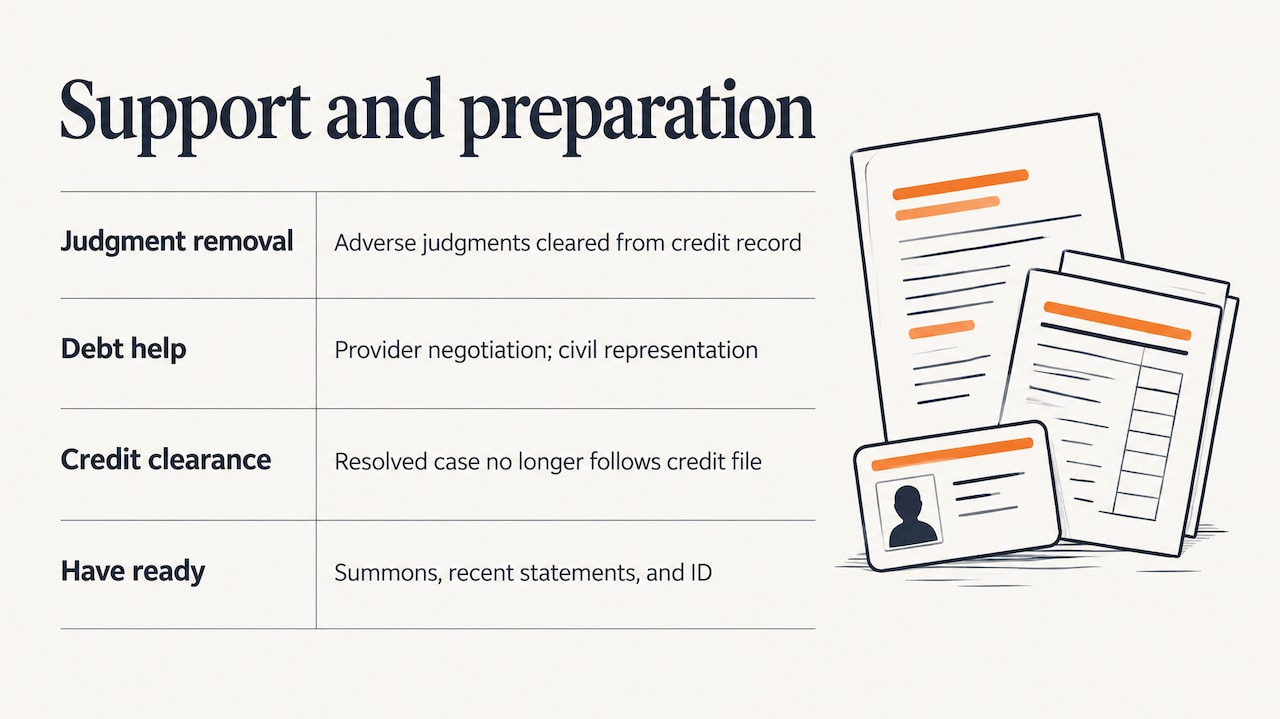
When a judgment has already been entered, an EAO has been issued, or the dispute is more complex than a simple missed payment, this is where we come in. Our judgment removal service focuses on clearing adverse judgments from your credit record, while our broader debt help services cover negotiation with credit providers and representation in civil matters. We also handle credit record clearance so a resolved case does not keep following you around on your credit file.
Before reaching out, have a copy of your summons, recent account statements, and your ID ready. It makes the first conversation faster and gives a clearer picture of your situation.
A straight word on urgency and the mistakes that cost people the most
The single biggest mistake we see is letting the 10-day window slip by because the summons felt like something that could wait. It cannot. The second most common mistake is making a verbal promise to a collector and assuming that counts as a defence, it does not, and nothing beats a written, dated record of every conversation. Act early, document everything, and bring in registered, accountable help before a deadline forces your hand.
— Maria. Maxlaw Senior Advisor
Get help before your court date arrives
A debt summons does not have to end in a default judgment or a damaged credit record, and we help South African consumers work through exactly this situation every day through debt help and judgment removal services built around real legal casework, not just paperwork.
Before you contact us, have three things ready: a copy of the summons, your ID, and your recent account statements. From there, we can tell you exactly where your case stands and what your realistic options are. Start with our debt help page to see how the process works.
FAQ
What happens when you don’t pay your debt in South Africa?
Unpaid debt can lead to a creditor issuing a court summons, and if you fail to respond within the required deadline, the court can grant a default judgment against you. From there, enforcement options like a warrant of execution or an emolument attachment order can follow, along with a negative mark on your credit record.
What are the 11 words to say to a debt collector?
There is no official or legally recognised script that resolves a debt collection call, and relying on an internet phrase instead of your actual rights can leave you worse off. The protections that genuinely matter come from the National Credit Act, which governs what collectors can and cannot do.
How does a provisional sentence summons work?
A provisional sentence summons is used when a creditor holds a liquid document, such as a signed acknowledgement of debt, where the amount owed is already certain and not easily disputed. It moves faster than a standard summons and places more pressure on you to raise a solid defence quickly.
What is the new debt law in South Africa?
Recent regulatory attention has focused on tightening oversight of emolument attachment orders, requiring court authorisation and applying safeguards like a 25% cap guideline on salary deductions, according to National Credit Regulator guidance. The underlying framework remains the National Credit Act, with these updates aimed at closer court oversight rather than a complete overhaul.
Can a judgment be reversed after it’s granted?
Yes, a default judgment can sometimes be rescinded if you can show good reason for not responding in time and a genuine defence to the claim. This is handled through a formal rescission application to the same court that granted the judgment, and it is worth discussing with a legal adviser quickly since delays can weaken your case.
Sources
-
No. R. 740: Rules Board for Courts of Law — Civil Procedure rules (Magistrates’ Courts rules)
-
NCR circular on emolument attachment orders and related safeguards