
The in duplum rule says that when you are in arrears, the interest a creditor charges cannot keep growing once it equals the capital you still owe. Owe R20 000 in capital, let R20 000 of arrear interest build up, and the interest stops running. That is the short version. The longer version matters, because the rule has limits, it behaves differently after a court judgment, and the National Credit Act (NCA) adds a stronger layer for consumer credit agreements.
If a lender has told you that you now owe far more than you borrowed, this article will help you work out whether the rule applies to you and what to do next.
TL;DR
- The common law rule stops arrear interest from accruing once it equals the outstanding capital debt.
- For credit agreements covered by the NCA, the statutory version is more favourable to consumers because it reaches beyond interest alone.
- A court judgment lets interest run afresh from the date of judgment, so the rule is not a permanent shield.
- A credit agreement cannot sign the rule away: a clause saying it does not apply is unenforceable.
- If a judgment or listing is blocking your credit, a legal route exists to challenge or clear it.
Table of Contents
- What the in duplum rule actually says
- Why the law has this rule
- Common law versus the National Credit Act
- Where the protection ends: judgments
- Can a creditor contract out of the rule?
- Does it only apply to loans?
- Spring cleaning your debt position
- Our perspective at MaxLaw
- When the rule is not enough: judgments and listings
- How MaxLaw can help
- Practical points to keep in mind
- FAQ
- Sources
What the in duplum rule actually says
In duplum is Latin for “double the amount”. The idea has been part of South African law for a very long time, and it is a simple one: a debt should not be allowed to swell without limit just because it stays unpaid.
The common law version applies to arrear interest. Once the unpaid interest reaches the amount of the outstanding capital, it ceases to accrue. The name can mislead. The rule does not say the creditor may charge you up to double the loan on top of the loan. It says the interest that has built up while you were in default cannot exceed the capital, so the total you owe is capped at roughly twice the capital, before payments are considered.
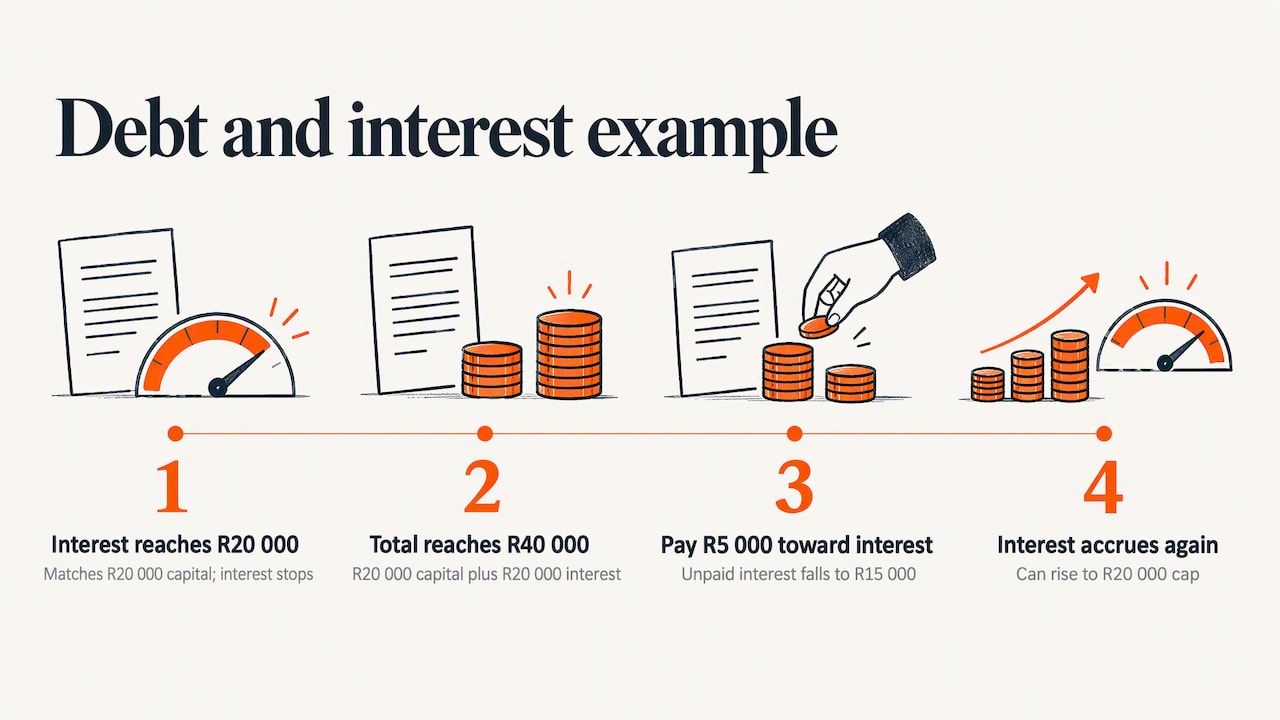
The rule also moves with your payments. According to the government’s draft NCA interpretation guidelines, when payments bring unpaid interest back below the outstanding capital, interest can begin to run again until it reaches the limit once more. Think of it as a ceiling that sits above your debt, not a switch that is turned off forever.
A worked example
This is an illustration, not a real case. Say you borrowed R20 000 and fell behind. Your contract charges interest on the unpaid balance. Over a few years of non-payment, the arrear interest grows to R20 000. At that point the interest stops. You owe R20 000 in capital and R20 000 in interest, a total of R40 000, and no more interest can be added while the position stays like that.
Now suppose you pay R5 000 towards the interest. Unpaid interest drops to R15 000, which is below the capital. Interest may start accruing again until it climbs back to R20 000. That is why a payment arrangement, even a small one, changes the picture and why you should always ask for a fresh statement afterwards.
Why the law has this rule
The Constitutional Court has described the purpose in terms of public policy. In the Paulsen v Slip Knot Investments judgment, the court explained that the rule protects a debtor who has already been broken by debt from being buried further by interest he can never realistically pay, while still respecting the creditor’s right to recover what is owed.
It also pushes creditors in a useful direction. Commentary in De Rebus, the journal of the legal profession, notes that capping interest encourages lenders to act promptly rather than let debts balloon for years. For you, that means a creditor who has sat on your account has less room to profit from the delay than they might think.
Common law versus the National Credit Act
This is the distinction most consumers miss, and it can change your numbers a great deal.
The common law rule covers arrear interest only. The NCA contains its own statutory version in section 103(5). The Supreme Court of Appeal in Nedbank v National Credit Regulator dealt with how this statutory protection works in a debt review setting, and the practical lesson from that line of cases is that the statutory rule is more favourable to the consumer than the common law rule. It caps a wider range of costs, not interest alone.
In practice, this means the type of agreement you signed matters:
| Feature | Common law rule | NCA statutory rule |
|---|---|---|
| Where it comes from | Long-standing case law | National Credit Act, section 103(5) |
| What it caps | Arrear interest | Interest and certain other charges on the debt |
| Which agreements | Debts outside the NCA, such as many commercial loans | Credit agreements governed by the NCA |
| Can the contract exclude it? | No, it rests on public policy | Statutory protection for the consumer |
Most personal loans, store accounts, credit cards, vehicle finance and home loans taken by individuals fall under the NCA. Business loans between companies and some large transactions usually do not. If you are unsure which regime covers your agreement, that is the first question a credit lawyer will ask you, and it is worth answering before you negotiate a single rand.
Where the protection ends: judgments
Here is the part that catches people off guard. The rule limits interest during the arrears period, but a court judgment resets the clock.
In Paulsen, the Constitutional Court confirmed that interest on a judgment debt may run anew from the date of judgment until the debt is settled, with a fresh limit based on the judgment amount. In 2023 the Supreme Court of Appeal confirmed in the Bovicon matter that the rule will not rescue a debtor in this position, as summarised by Cliffe Dekker Hofmeyr.
Put simply: if a creditor sues, wins and you then ignore the judgment, you can find yourself in a second debt spiral. The cap that protected you before may not be the cap that applies now. This is exactly why acting early, before summons turns into judgment, is kinder to your finances than waiting.
Can a creditor contract out of the rule?
No. Some agreements include fine print stating that the in duplum rule will not apply. Courts have held that such a clause cannot be enforced, because the rule exists to protect vulnerable debtors and cannot be waived by a signature. If a statement from a lender looks as though interest has run far beyond the capital, the contract wording is not the end of the conversation.
Does it only apply to loans?
The rule is not limited to bank loans. South African courts have considered it in many settings, including municipal debts and a labour dispute over unpaid allowances. The outcome depends on the facts: in some cases the court found the rule applied, in others it did not. That is a reason to have your own papers read, rather than assume a case you read about online mirrors yours.
Spring cleaning your debt position
We like to think of a financial review as a spring clean: you go through every drawer, decide what stays, what goes and what deserves room to grow. Debt is the cupboard most people avoid, usually because it feels like a verdict on them. It is not. It is a set of documents, dates and amounts, and the in duplum rule is one of the tools that helps you sort them.
Sit down with the paperwork and gather the following in your own time, without rushing: the original credit agreement, your latest statement, any letter of demand or summons, any judgment, and your credit report. Look at three things in particular. First, what was the original capital? Second, how much of what the lender claims is interest, and how much is fees and charges? Third, has a court already granted judgment? Those three answers tell you which rules apply, and whether the lender’s number is even possible.
You can request your credit report from the credit bureaus, which gives you a clear view of what lenders see. Our article on interest rate versus APR is also a helpful companion if you want to understand how the cost of credit is shown to you before you sign.
Our perspective at MaxLaw
We have helped more than 250 000 South Africans with credit problems since 2008, and the same pattern comes up repeatedly. People arrive with a statement that makes no sense, a lender who insists the figure is correct, and a quiet belief that there is nothing to be done. Very often the first step is simply reading the numbers against the law.
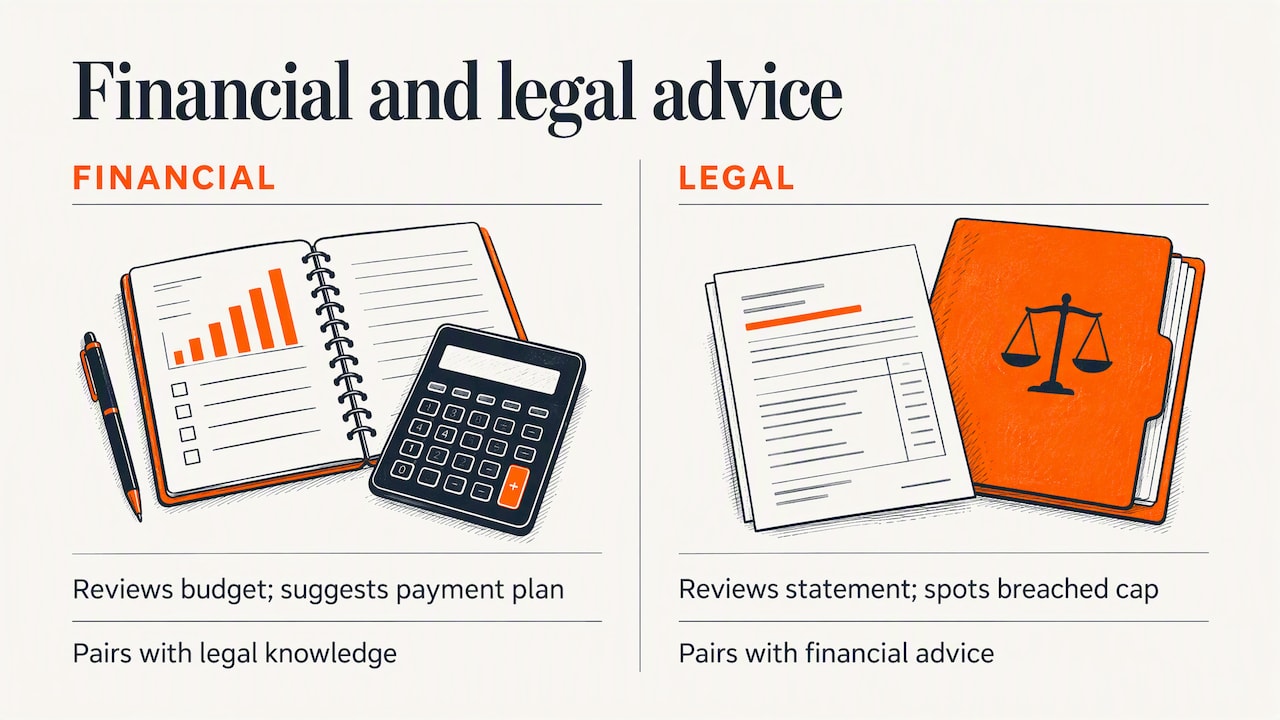
The in duplum rule is a good example of why we pair legal knowledge with financial advice. A purely financial adviser might look at your budget and suggest a payment plan. A purely legal one might look at the statement and spot a cap that has been breached. Both views matter. If interest has been charged beyond what the law allows, that should be raised before you commit your monthly income to a settlement.
We also want to be honest about its limits. The rule is not a magic eraser. It does not remove the capital you borrowed, it does not wipe an adverse listing, and after a judgment the picture changes. What it does is give you a firm footing in a negotiation, and sometimes a reason to challenge a number that was never lawful.
Our advice is always to look early, ask questions and avoid signing anything you have not understood. Debt feels heavy mostly because it is unexamined. Once you have the facts on the table, you can decide calmly what to do, and that is where the weight begins to lift.
— Maria
When the rule is not enough: judgments and listings
Even a correctly capped debt can leave damage behind. A judgment or an adverse listing on your credit record can block a vehicle finance application, a bond or a rental application long after you have started paying. Understanding in duplum helps with the amount you owe. It does not, by itself, change how lenders see you.
That is where legal intervention comes in. If a judgment was granted wrongly, has been paid, or should not be reflected on your record, there are legal processes to challenge it. We explain what they involve on our page about judgment removal. If your problem is mainly that repayments have become unmanageable, our debt help page sets out how we approach renegotiating with credit providers and looking at your options, including help if you are already under debt review.
For readers asking about the difference between counselling and review, we have written a separate guide on debt counselling versus debt review. And if you want help choosing who to work with, our guide to choosing the right credit legal provider lists the questions worth asking any provider.
How MaxLaw can help
If you have a statement you suspect is wrong, a judgment you want reviewed, or a credit record that keeps costing you loans, we can look at it with you. We combine legal expertise with financial advice, work through direct legal processes rather than only administrative requests, and have branches across the country, so you do not need to travel far to speak to someone. Start at maxlaw.co.za or see our credit repair service to understand what a mandate with us looks like. We do not publish fixed prices, because the work depends on your case, so the first conversation is about your facts and what is realistic.
Practical points to keep in mind
A few habits make the rule work in your favour rather than against you.
Keep every statement. The capped figure is only provable if you can show the capital, the interest and the payments in sequence. Lenders’ systems change, and a gap in your own records makes it harder to dispute a number later.
Do not ignore a summons. The rule helps most before judgment. A debtor who responds, asks for a breakdown and negotiates gets far better outcomes than one who lets the matter run to default judgment, after which interest can restart on the judgment amount.
Remember that fees are a separate question. Under the common law, the rule concerns arrear interest. Whether collection costs, insurance and administration fees fall inside the cap depends on the agreement and on whether the NCA applies, so ask for a line-by-line breakdown rather than a single total.
Be wary of anyone who promises that your debt will vanish. The rule limits growth. It does not cancel what you owe, and a provider who tells you otherwise is not reading the law the way the courts do.
FAQ
Does the in duplum rule apply to all debt in South Africa?
It applies widely, but how it works depends on the debt. The common law rule limits arrear interest on many kinds of debt, and the NCA contains a statutory version for credit agreements it governs. Courts have decided the rule’s application case by case, so your agreement needs to be read before anyone can say what applies.
Does interest stop forever once it reaches the capital amount?
No. It stops while the unpaid interest equals the capital, but it can begin running again if your payments reduce the unpaid interest below that level. After a court judgment, interest can also run anew on the judgment debt.
Can a lender write the rule out of my contract?
No. Courts have held that a clause excluding the rule is unenforceable, because the rule rests on public policy and cannot be waived. If your agreement says otherwise, get it reviewed by a legal professional before you pay.
Does the rule remove a judgment or a bad credit listing?
No. It limits how much interest can accumulate. A judgment or adverse listing is dealt with through separate legal processes, which is what our judgment removal service addresses.
Who should I speak to if I think I have been overcharged?
Start by asking the lender for a full statement showing capital, interest, fees and payments. Then take it, along with your agreement, to an attorney who handles credit law, or to a debt counsellor if you are considering formal debt review. We can review your papers and tell you plainly where you stand.
Sources
- eThekwini Municipality v Verulam Medicentre, Supreme Court of Appeal (2005)
- Paulsen and Another v Slip Knot Investments 777, Constitutional Court (2015)
- Nedbank v National Credit Regulator, Supreme Court of Appeal (2011)
- Smartgrid Engineers v Protea Mines, High Court Pretoria (2019)
- National Credit Act: Guidelines for interpretation and application (draft), gov.za
- Cliffe Dekker Hofmeyr: the in duplum rule and post-judgment interest (6 July 2023)
- De Rebus: Interested about the interest in debt? The in duplum rule revisited (August 2015)
- Labour Court, Cape Town (2023): in duplum and arbitration award interest