
An ITC clearance, formally called a Form 19, is the official debt review clearance certificate issued by a registered debt counsellor once your restructured debts are paid up. Your next move is simple: confirm you qualify, gather your paid-up letters from every credit provider, and ask a registered debt counsellor to issue and file the certificate with the credit bureaus under Section 71 of the National Credit Act.
TL;DR:
You qualify if every rearranged debt is paid in full, or if short term accounts are settled while a mortgage meets Section 71(1)(b) exception rules.
Gather a letter confirming payment in full from each creditor, your ID, counselling reference, and proof that all fees are settled before requesting Form 19.
Check that the platform shows your completion code; your counsellor must file Form 19 and certified copies with credit bureaus within seven days.
After clearance, bureaus remove the debt review flag, triggering defaults, and review notes, but payment history remains on file under Regulation 17.
Challenge an incorrect listing in writing; if the bureau fails to provide credible evidence or remove it within 20 business days, escalate to the NCR.
Table of Contents
What is ITC clearance and who can issue it?
Think of debt review like a financial spring clean. For years, your credit file has carried a flag showing you were under review, and once the restructured debts are settled, that flag needs to come off so the rest of your record can breathe. The National Credit Act governs this process under Section 71, and only an NCR-registered debt counsellor may issue the clearance certificate known as Form 19. The counsellor also carries filing obligations once the certificate is issued.
A clearance certificate corrects your debt review status. It does not erase your ordinary payment history, which is a distinction worth holding onto as you plan your next steps.
-
Form 19 is issued only by a debt counsellor registered with the NCR.
-
The certificate confirms your debt review has ended, not that your full credit history disappears.
-
Filing with the credit bureaus is a legal obligation, not an optional courtesy.
Who qualifies and what paperwork to gather first
Before you contact anyone, it helps to know which door you’re walking through. There are two main eligibility routes under the Act: either every re-arranged debt has been paid up in full, or your short-term accounts have been settled while a mortgage remains under the exception rules described in Section 71(1)(b). Knowing which one applies to you shapes the whole conversation with a debt counsellor.
Once you know your route, start collecting the paperwork. Missing documents are the single biggest reason clearance stalls, so treat this stage like clearing out a cupboard before the movers arrive: everything needs to be accounted for.
-
Paid-up letters from every credit provider involved in your debt review.
-
A copy of your ID and any reference numbers from the debt counselling platform.
-
Proof that your debt counselling fees are fully settled, with no balance outstanding.
Common blockers include a single creditor refusing to issue a paid-up letter, a counselling fee dispute, or a mismatch between what you believe is paid and what the credit provider’s system shows.
Your step-by-step checklist for filing Form 19
Getting clearance filed correctly is less about paperwork volume and more about sequence. Follow these steps in order and you’ll avoid most of the delays that trip other consumers up.
-
Pull your credit report from the major bureaus and list every account that shows a debt review flag.
-
Request a paid-up letter from each credit provider named on that list, since these letters are the evidence your debt counsellor will rely on.
-
Confirm with your debt counsellor that no counselling fees remain outstanding and that your status on the debt counselling platform reflects the correct completion code.
-
Ask your registered debt counsellor to issue Form 19, upload it via the Credit Bureau Association’s debt counselling platform, and file certified copies with the credit bureaus within seven days of issuance, as the NCR’s filing guideline requires.
-
Monitor your credit report for the bureau update and hold onto your certified filing reference in case you need to prove the date of submission.
-
If filing hasn’t happened within the statutory window, escalate directly to the NCR rather than waiting indefinitely.
Pro Tip: Ask your debt counsellor for the CBA platform submission reference the same day Form 19 is issued, not weeks later when it’s harder to trace.
The platform itself checks your debt counselling status before accepting the filing. If that status hasn’t been updated on the system, your submission can bounce back with a rejection code, and your counsellor will need to fix the status before resubmitting.
What to expect on timing and cost
Patience matters here, but so does knowing the actual deadlines rather than guessing. Once a debt counsellor issues your Form 19, the law requires a certified copy to reach every credit bureau within seven days, per NCR guidance on Section 71(4). After that, bureaus typically need a short additional window to reflect the update on your file.
Dispute investigations follow a firm 20 business day window. During this time, a credit bureau must produce credible evidence or remove the disputed listing, under Section 72(3) and Regulation 20(2). That deadline gives you a concrete point to hold a bureau accountable to.
-
Filing: seven days from issuance of Form 19.
-
Bureau system update: a short additional window after filing.
-
Dispute resolution: 20 business days for bureaus to investigate or remove.
Fees for issuing and filing a Form 19 vary between debt counsellors and law firms, so ask for a written quote before you commit rather than assuming a flat rate applies.
What actually changes on your credit file after clearance
This is where the spring clean metaphor earns its keep: clearance decides what stays, what goes and what deserves to stay visible for good reason. Under Section 71(5), once a bureau receives your clearance certificate it must expunge the debt review flag itself, the defaults that triggered the review in the first place, and any note that the agreement was ever subject to debt review.
What doesn’t disappear is your payment history. NCR guidance confirms that payment profile information stays on file according to Regulation 17 retention periods, and that’s deliberate rather than an oversight.
-
Removed: the debt review flag and the defaults that led to it.
-
Removed: any record that the account was subject to debt review.
-
Retained: ongoing payment history, as Regulation 17 requires.
Keeping payment history intact actually protects you. Without it, lenders see a blank space instead of a track record, which can make new credit harder to access rather than easier, a problem consumer finance reporting has flagged as a real risk for cleared consumers. The fix is for credit providers to keep submitting payment data throughout and after your review, so your file reads as current rather than empty.
If the bureau won’t correct your record: dispute and escalation
Sometimes a bureau simply doesn’t update despite a properly filed Form 19. When that happens, there’s a clear path forward rather than a dead end.
-
Lodge a dispute directly with the credit bureau, in writing, referencing your certified Form 19 filing.
-
The bureau must then seek credible evidence from its data supplier within 20 business days, and a bare confirmation from the creditor does not meet that bar: contracts, system logs and paid-up letters do.
-
If the bureau fails to respond with credible evidence in that window, the information must be removed.
-
Where the bureau still won’t act, lodge a formal complaint with the NCR, and if that doesn’t resolve it, an application to the National Consumer Tribunal is the next recourse.
What we’ve seen speed up clearance cases
Working alongside debt counsellors on clearance matters, we’ve noticed the cases that move fastest are the ones where evidence gets collected early rather than scrambled together after a rejection. Pairing legal steps such as judgment removal or rescission with the documentary groundwork for Form 19 tends to prevent the back-and-forth that otherwise stretches a straightforward filing into months.
Our practical advice from these cases: request paid-up letters the moment your last payment clears, keep a certified copy of your Form 19 the day it’s filed, and confirm your debt counselling platform status directly rather than assuming it updated automatically.
How we help you get your credit record cleared
We combine legal casework and advisory, so the person handling your paid-up letters understands how Section 71 filing works and what the credit bureaus expect to see. That combination tends to close gaps that a purely administrative service would miss.

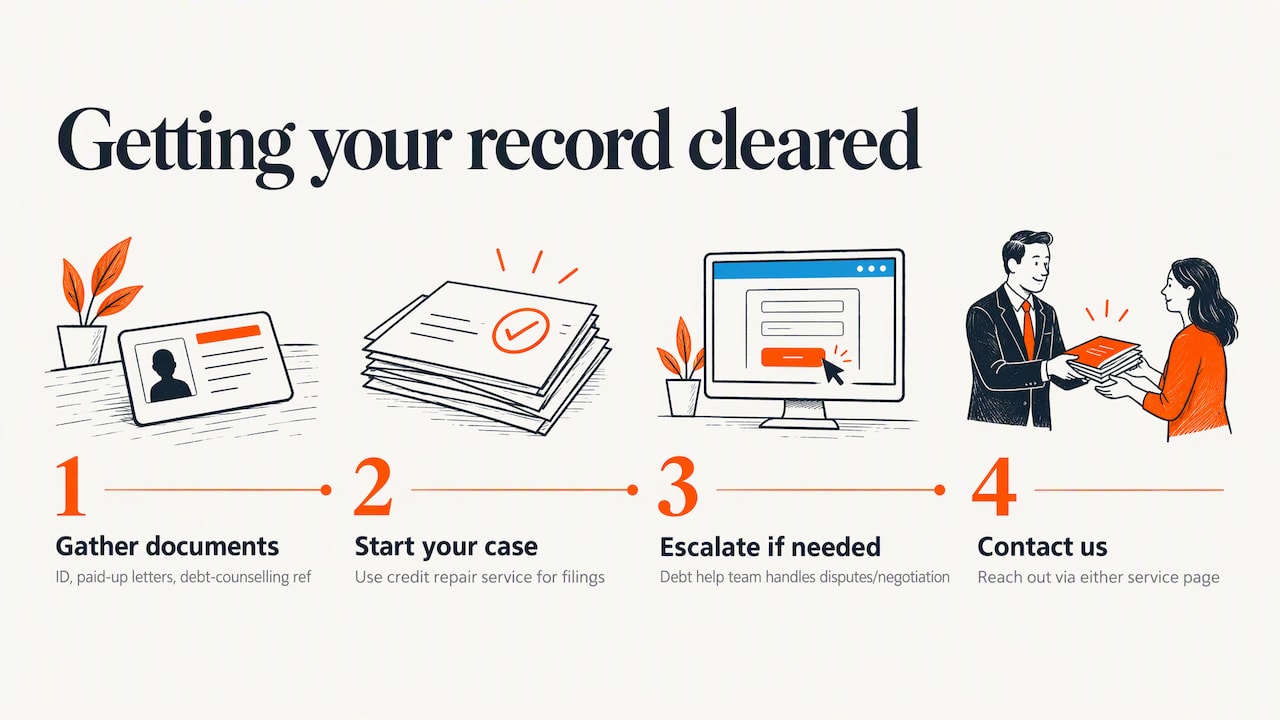
If you’re ready to start, gather your ID, your paid-up letters and your debt counselling reference number. From there, our credit repair service handles clearance filings directly, and our debt help team steps in where creditor negotiation or a stubborn dispute needs legal weight behind it. Reach out through either page to get your case started.
This article is general information, not a substitute for advice from a qualified financial advisor. Consult a qualified financial professional about your own circumstances before acting on anything here.
FAQ
What is an ITC clearance?
An ITC clearance, or Form 19, is the certificate a registered debt counsellor issues once your debt review is complete, confirming the debt review flag can come off your credit file. It’s filed directly with the credit bureaus rather than handled by the consumer.
How long does ITC clearance take?
Once issued, the debt counsellor must file a certified copy with the credit bureaus within seven days, with a further short window for the bureau to update your file. A dispute over an incorrect listing follows its own 20 business day timeline.
How can I clear my name from the credit bureau?
Confirm your restructured debts are paid up, collect paid-up letters from every credit provider, and ask a registered debt counsellor to issue and file Form 19. If a bureau fails to update your file afterward, you can dispute it and, if needed, escalate to the NCR.
What is an ITC check in South Africa?
An ITC check refers to a lender or employer reviewing your credit file through a registered credit bureau such as TransUnion, Experian or XDS before extending credit or an offer. A cleared Form 19 on file helps that check reflect your current standing rather than an outdated debt review status.
Can MaxLaw handle my Form 19 filing for me?
Our credit repair service assists with gathering paid-up letters, liaising with your debt counsellor and following up on bureau filings. Pricing depends on the complexity of your case and is available on request.
Sources
For the exact legal wording and latest timelines, consult the National Credit Act directly alongside the NCR’s published guidelines on Form 19 filing and dispute handling linked throughout this article.