
A paid-up letter comes from your credit provider, or from the provider via your debt counsellor if you went through debt review, and it is the proof you need to clear an old account from your credit record. Request it in writing and keep every copy. If you were under debt review, your Form 19 and supporting letters need to reach the bureaus through the CBA’s Debt Help System, with the NCR and the Credit Ombud playing a role if anything stalls.
TL;DR:
A valid letter must match your identity and account, state the final payment date and zero balance, and include the issuer’s signature, title, and contact details.
If formal debt review settled all accounts, your debt counsellor files certified Form 19 with provider letters; bureaus must receive it within seven days.
For debts settled outside debt review, dispute the listing directly; bureaus must mask disputed information within five business days and resolve complaints within 20.
A provider letter alone cannot clear a judgment; obtain satisfaction or rescission documentation, and confirm how a reduced settlement will be described before accepting.
Table of Contents
-
How to submit paid-up letters and get your credit record updated
-
If a provider delays or refuses: dispute and escalation options
-
How Legal services can assist with paid-up letters and credit record clearance
-
Paid-up letters versus clearance certificates: what is the difference
What a paid-up letter is and what it must include
A paid-up letter is written confirmation from a credit provider that you have settled an account in full. It carries weight because it becomes your evidence when a bureau or a court needs proof that a debt no longer exists. Without it, an old account can sit on your credit report long after you have paid it off, quietly working against you every time a lender or landlord checks your history.
The letter itself is a simple document, but it only does its job if it contains the right details. When you ask your provider for one, make sure it includes:
-
Your full name and identity number, matched exactly to the account
-
The account or reference number tied to the debt
-
The date the final payment was made and cleared
-
A statement that the balance is now zero
-
The signature, title, and contact details of the person or department confirming it
These fields matter because a bureau or debt counsellor checking your file needs to match the letter to your record without guesswork. A letter missing a date or an account number often gets rejected, which sends you back to square one.
If you went through debt review, the paid-up letter from each provider becomes a supporting document for your Form 19, the clearance certificate your debt counsellor files once every account is settled. Section 71(4) of the National Credit Act requires the debt counsellor to lodge a certified copy of that clearance certificate with every credit bureau within seven days, and it needs the provider letters attached to prove each account is genuinely cleared, not just one of several debts paid off. The guideline on filing clearance certificates sets this out clearly for debt counsellors and the bureaus that must act on it.
Keep a small folder of supporting evidence alongside the letter itself: your proof of payment, the relevant bank statement showing the transaction, and any receipt the provider issued at the time. These documents back up the paid-up letter if a bureau later asks for more than the letter alone, and they save you from digging through old statements under pressure.
Who issues paid-up letters and in which situations
The right person to approach depends entirely on how the debt was managed and settled. Getting this wrong wastes time, since the wrong department often cannot issue what you need.
-
The original credit provider, such as a bank, retailer, or furniture store, issues the paid-up letter for an account you settled directly, outside of debt review.
-
Your debt counsellor coordinates the paperwork when you went through formal debt review, gathering a paid-up letter from each provider and then filing the Form 19 clearance certificate under section 71(4) of the National Credit Act once every account is confirmed settled.
-
A collection agency or attorney firm handling the debt on the provider’s behalf issues its own confirmation once a judgment debt or handed-over account is paid, often phrased as a settlement or satisfaction letter rather than a standard paid-up letter.
-
A court-related judgment needs a satisfaction of judgment document, separate from a simple paid-up letter, confirming the judgment debt itself has been paid and can be removed from the civil record that feeds into your credit report.
-
An account written off as uncollectable, sometimes shown as “paid in full for less than owed” or a negotiated settlement, usually generates confirmation text that differs from a standard paid-up letter, and you should ask specifically how the provider will word it before accepting a settlement offer.
Knowing which of these applies to you before you start calling around saves a surprising amount of back and forth.
How to request and obtain a paid-up letter
Once you know who should issue the letter, the process itself is straightforward if you follow it in order and keep records at every step.
-
Gather your evidence first. Pull together your proof of payment, the bank statement showing the transaction clearing, and any receipt or confirmation number from the time you paid.
-
Write a short, specific request. Include your full name, identity number, the account number, the date you made the final payment, and your current contact details. Ask directly for a paid-up letter confirming a zero balance.
-
Send it through a channel that leaves a trail. Email with a read receipt works well, as does registered post or the provider’s own online portal if it has one. A phone call alone leaves you with nothing to show a bureau later.
-
If you are under debt review, go through your debt counsellor. Instruct them to upload the provider’s paid-up letter to the CBA platform and confirm it forms part of your Form 19 filing rather than handling it separately yourself.
-
Set a follow-up date. Give the provider seven to ten business days to respond, then follow up in writing again, referencing your original request and the date you sent it.
-
Escalate if there is still no response. If a provider ignores repeated written requests, you can move to a formal bureau dispute, which has its own regulatory timeline, covered in detail further down.
Keep every document named clearly and stored together, ideally in one folder per account, so that if a dispute becomes necessary later you are not scrambling to reconstruct a paper trail.
Pro Tip: Name your files with the account number and date first, like “123456_PaidUp_2026-01-15.pdf”, so a bureau or debt counsellor can find the right document in seconds instead of opening five files to check.
Written records matter more than most people expect. A bureau dispute or a Credit Ombud complaint moves faster when you can show exactly when you asked, what you asked for, and how the provider responded, or failed to.
How to submit paid-up letters and get your credit record updated
Getting the letter is only half the job. It needs to reach the right system before your credit record actually changes, and there are two main routes depending on how your debt was settled.
If you settled an account directly with a provider, outside debt review, you submit a dispute to the credit bureau holding the incorrect listing. Most bureaus accept this through an online dispute form or a dedicated email address, and you should attach the paid-up letter along with your identity document and any supporting proof of payment. The bureau will issue a reference number for your dispute, which helps you track progress and serves as an identifier if escalation becomes necessary.
Bureaus must mask the disputed information within 5 business days of receiving a complete complaint, and resolve the dispute within 20 business days, according to the NCR’s guidelines on disputed credit information. This means the negative listing should not show up against you while the bureau investigates, and if the bureau cannot get credible evidence supporting the original negative listing within that window, it must correct or remove it entirely.
If you went through debt review, the route runs through your debt counsellor and the Credit Bureau Association’s platform rather than a direct bureau dispute.
-
Your debt counsellor collects paid-up letters from every credit provider once all accounts are settled.
-
They file a certified Form 19 clearance certificate through the CBA’s authentication platform, which checks your status against the Debt Help System.
-
Submissions through this platform typically sync to the bureaus’ own systems within a few business days of verification, according to the NCR’s February 2026 guideline on Form 19 filing.
-
This route tends to be faster and cleaner than an individual dispute because it clears every account in one certified filing rather than one listing at a time.
If you want to check where things stand with a specific data holder, Experian’s clearance letter guidance points consumers to contact them directly, with a phone number and email address set up specifically for clearance letter queries. It is a practical first call if your paid-up letter relates to an Experian-held listing and you are unsure whether it has been processed yet.
If a provider delays or refuses: dispute and escalation options
Most paid-up letter requests go smoothly, but a provider that drags its feet or refuses outright does not get the final word. There is a clear escalation path, and each step has its own timeline and evidence requirements.
-
Escalate with the provider first, in writing. Reference your original request, attach copies of everything you already sent, and give a firm but reasonable deadline, generally about a week.
-
File a formal bureau dispute if the provider still does not respond. Attach your paid-up evidence and any proof of your written attempts to resolve it directly. Note the bureau’s reference number and track it against the 20 business day resolution window the NCR’s dispute guidelines set out.
-
Submit Form 29 to the NCR if the bureau dispute does not resolve the issue. This form, provided for under the National Credit Act, lets you lodge a formal regulatory complaint when a credit provider or bureau is not complying with its obligations, and it should include your account details, a timeline of your attempts to resolve things, and copies of every piece of correspondence.
-
Bring in the Credit Ombud when the matter still is not settled. The Credit Ombud’s process moves through assessment, facilitation, and mediation before reaching a formal recommendation or ruling, and for member credit providers, that ruling can be binding.
-
Consider legal assistance when a judgment is involved or the provider shows persistent non-compliance. A judgment debt that has been paid still needs a formal rescission or satisfaction process to come off your record, and a provider that ignores repeated regulatory escalation is often a sign that legal representation will move things faster than continuing alone.
Each step builds on the paper trail from the one before it, which is why keeping dated, written records from day one makes every later stage faster.
How Legal services can assist with paid-up letters and credit record clearance
Some paid-up letter situations are simple: one call, one email, one document, done. Others involve a provider that has gone quiet, a judgment that needs formal rescission, or a debt review exit that has stalled somewhere between the debt counsellor and the bureau. That gap between a straightforward request and a genuinely stuck case is where legal help earns its keep.
We handle the parts of this process that consumers often find hardest to push through on their own, including collecting outstanding paid-up letters, preparing supporting documentation, liaising with credit bureaus, filing complaints with regulatory bodies, and managing court-related work where necessary.
If your situation is a single account with a cooperative provider, writing the request yourself and following up in writing is often enough, and the steps earlier in this guide should get you there. Legal help tends to make the real difference when a provider is unresponsive, when a judgment is involved, or when you are juggling multiple accounts across different providers and debt review timelines at once.
Engagement with legal services usually starts with a review of your credit report and affected accounts, followed by outreach to relevant providers or bureaus on your behalf, with updates on the status of disputes or filings. Since 2008, our team has worked with South African consumers on exactly this kind of credit record clearance, combining legal process with practical advisory support rather than leaving you to interpret regulatory forms alone.
How a paid-up letter affects your credit score and report
A paid-up letter itself does not change your score the moment you receive it. What matters is what happens after you submit it: once a bureau updates the listing to reflect a zero balance or removes an outdated negative account entirely, your credit report starts to reflect your actual payment history rather than an account that looks unresolved.
Lenders and credit scoring models weigh outstanding or defaulted accounts heavily, so an account that still shows as unpaid, even after you have settled it, continues to drag on your score until the correction lands. This is why the timing matters: the sooner your paid-up letter reaches the bureau and gets processed, within the 20 business day window the NCR’s complaint guidelines describe, the sooner your report starts to recover. A cleared listing does not erase the history of the debt, but it does stop the account from counting against you as if it were still outstanding, which tends to matter most when you apply for new credit soon after settling.
Your legal rights around paid-up letters in South Africa
South African consumers have specific, enforceable rights when it comes to correcting credit information, not just a general expectation of fairness. The National Credit Act gives you the right to inspect the information bureaus hold about you and to challenge anything inaccurate or outdated, with the regulatory process built around clear timelines rather than open-ended promises.
You have the right to dispute a listing and have it masked while under investigation, to receive a resolution within the bureau’s 20 business day window, and to escalate to the NCR through Form 29 or to the Credit Ombud if that process fails you. You also have the right to a paid-up letter itself once you have settled a debt. A credit provider that refuses to confirm a zero balance in writing, without good reason, is not meeting its obligations under the broader consumer credit framework, which is exactly the kind of situation the NCR and Credit Ombud exist to address.
Paid-up letters versus clearance certificates: what is the difference
These two documents often get used interchangeably, but they are not the same thing, and mixing them up causes real delays.
A paid-up letter is issued by an individual credit provider and confirms that one specific account has been settled in full. A clearance certificate, known formally as a Form 19, is issued only in the context of formal debt review, and it confirms that every debt under that debt review arrangement has been paid off, not just one account. Your debt counsellor compiles the paid-up letters from each provider as supporting evidence, then files the Form 19 itself with the bureaus under section 71(4) of the National Credit Act.
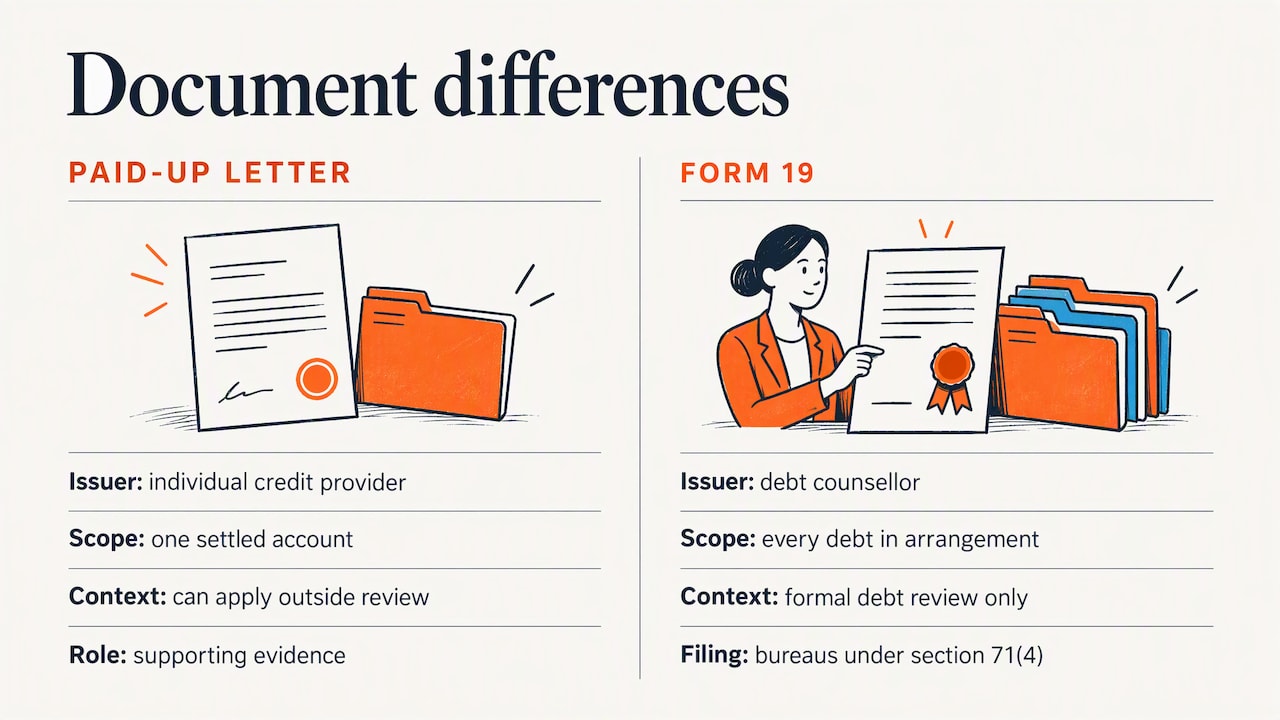
In practice, if you paid off a single account outside debt review, you only ever need a paid-up letter. If you completed a full debt review programme, you need the Form 19 clearance certificate, and the paid-up letters exist mainly as the paperwork behind it.
What a paid-up letter typically costs to obtain
Requesting a paid-up letter from your own credit provider is generally free. Providers are expected to confirm settlement of an account they hold, and most do so at no charge when you request it in writing, since it is simply a factual confirmation of your own payment history.
Costs tend to appear when the situation gets more complicated: a provider that will not respond, a judgment that needs formal rescission through the courts, or a debt review exit that has stalled and needs legal intervention to unstick. In those cases, the cost reflects the legal or administrative work involved rather than the letter itself. If you reach that point, it is worth asking any legal provider you approach for a clear breakdown of fees before you commit, since the scope of work varies significantly between a single bureau dispute and a full judgment rescission.
Quick tips and common pitfalls from practice
The biggest mistake we see is consumers accepting a verbal confirmation that an account is settled and assuming that is enough. It never is. Without a written letter, you have nothing to attach to a bureau dispute or a Form 19 filing, and you are starting from zero the moment a correction is needed.
The second most common pitfall is losing track of reference numbers. A bureau dispute reference, a debt counsellor’s case number, a provider’s account number: these small details are what let anyone helping you pick up exactly where you left off. Save them in one place, not scattered across old emails.
Deadlines are more forgiving than people expect, provided you act within them rather than around them. The 20 business day bureau window and the Credit Ombud’s structured process both exist to protect you, but they only work if you follow up in writing and keep a paper trail from day one.
— Maria
How MaxLaw can help you clear your credit record
If you have settled a debt and the paid-up letter process has stalled, or you are facing a judgment that needs formal removal, we offer a direct route to resolving it rather than leaving you to manage bureaus, debt counsellors, and providers on your own.
Our credit repair service covers collecting paid-up letters, preparing bureau dispute documentation, and following through on corrections until your report reflects reality. If a court judgment is part of the picture, our judgment removal service handles the formal rescission process a simple paid-up letter cannot resolve on its own. Readers still working through formal debt review, or wrapping one up, may find our debt help service more relevant, particularly where a Form 19 filing has gone quiet.
To get started, have your identity document, account numbers, and any proof of payment or correspondence ready. We will review your credit report, identify what needs correcting, and handle direct communication with the relevant providers or bureaus on your behalf. Fees depend on the scope of work involved, from a single listing correction to a full judgment matter, and we discuss that with you before any work begins.
Our nationwide branch network means this kind of support is available wherever you are in South Africa, not just in major centres. If you are ready to move forward, reach out to start your credit repair review today.
This article is general information, not a substitute for advice from a qualified financial advisor. Consult a qualified financial professional about your own circumstances before acting on anything here.

FAQ
What is the meaning of “credit bureau”?
A credit bureau is an organisation that collects and holds consumer credit information, such as account histories, payment behaviour, and judgments, and compiles it into the credit report lenders use to assess you. In South Africa, bureaus operate under NCR oversight and must follow strict rules on accuracy, dispute handling, and correction timelines.
How do I write a paid-in-full letter?
A paid-in-full letter, more accurately called a paid-up letter when requested from a provider, needs to state the account holder’s name and identity number, the account number, the date of final payment, and a clear statement that the balance is now zero. Request it in writing, through email or registered post, and ask the provider to sign and date it with contact details included.
How do I get a totally free credit report?
South African consumers are entitled to one free credit report per year from each registered credit bureau, and you can request this directly through the bureau’s own website or offices. Checking your report regularly helps you catch outdated listings, including accounts that should already reflect a paid-up letter.
How do I get a paid-up letter?
Contact the credit provider directly, in writing, with your identity number, account number, and the date you made your final payment, and ask them to confirm the balance is zero. If you settled the debt through formal debt review, ask your debt counsellor to include the provider’s paid-up letter as part of your Form 19 clearance certificate filing through the CBA platform instead of requesting it separately yourself.