
A Section 129 notice is a statutory warning under the National Credit Act that a credit provider must send before taking you to court over missed payments. Do not ignore it: preserve the notice and any delivery proof, check every detail against your account, and either propose a written repayment plan or get legal advice within days, not weeks.
TL;DR:
Since March 13, 2015, providers may use registered mail to your nominated address or hand delivery to an adult, and must retain delivery proof.
Compare the arrears with your statements, preserve the envelope and tracking records, and note that providers usually must wait ten business days after proper delivery.
Debt counselling requires a counsellor registered with the National Credit Regulator, targets completion within 60 business days, and does not excuse you from agreed payments.
Use alternative dispute resolution for disagreements about balances or contract terms, and contact an ombud or consumer tribunal if you believe the provider acted unfairly.
If delivery records, the address, the arrears figure, or required resolution options are defective, a court can refuse enforcement until the provider fixes the problem.
Table of Contents
-
Delivery, proof and validity: what makes a Section 129 notice compliant
-
Step-by-step: what to do when you receive a Section 129 notice
-
Resolution routes the notice should propose and their practical effects
-
Consequences of ignoring the notice and common legal defences
-
Court cases that shaped Section 129 practice: Sebola, Kubyana and practical takeaways
-
MaxLaw perspective: why early legal review pays and what to expect from counsel
What section 129 requires and how it links with section 130
Think of a Section 129 notice as a pause button built into the law, a chance to sort things out before a credit provider heads to court. Section 129(1)(a) of the National Credit Act requires a credit provider to draw a default to your attention in writing before starting legal action, and to suggest a way forward rather than simply demanding payment. The notice should point you toward debt counselling, alternative dispute resolution, a consumer court, or an ombud, giving you a genuine chance to resolve the default by agreement.
That protective purpose only works if the notice actually reaches you, which is where section 130 comes in. Section 130 says a credit provider cannot approach a court for a default judgment or enforcement order unless it can prove the Section 129 notice was delivered. Courts have treated this proof requirement as close to compulsory in practice: without it, enforcement stalls, no matter how far in arrears the account is.
The Constitutional Court’s Sebola judgment shaped how this plays out in practice. The court explained that sections 129 and 130 work together: the notice exists to give you a real opportunity to respond, and the credit provider must show the notice was brought to your attention, not just posted somewhere and forgotten. Kubyana, decided later, confirmed that proof of delivery by registered post generally satisfies this requirement, provided the credit provider can produce the paperwork.
A handful of practical points follow from this framework:
-
The notice must clearly identify the default and the amount owing in understandable terms.
-
It must set out at least one route to resolve the default, such as debt counselling or an ombud referral.
-
Proof the notice was sent and received (or made available for collection) must exist before a court will grant enforcement.
-
Courts have generally accepted registered-post tracking records as sufficient proof, though the specific facts of each case still matter.
One figure worth remembering: the National Credit Act frames Section 129 as part of a deliberate pre-litigation process, designed so that going to court is a last resort rather than a first move. That framing matters when you are deciding how to respond: the law assumes you still have options at this stage, and the notice itself should list them.
Delivery, proof and validity: what makes a Section 129 notice compliant
Since an amendment that took effect on 13 March 2015, a credit provider has two main ways to deliver a Section 129 notice. The first is registered mail sent to the address you provided when you took out the credit agreement, your domicilium (that’s fancy legal wording for registered home) address. The second is hand delivery to an adult at the location you designated for this kind of notice. Either method, done properly, can satisfy the law, but the proof behind it has to hold up.
What counts as proof differs depending on the method used:
-
For registered mail, the credit provider typically needs the post office’s confirmation of posting and, ideally, tracking records showing the item reached your nominated branch or address.
-
For hand delivery, proof usually means a signature or written confirmation from the adult who received it, along with their relationship to you or the premises.
-
In both cases, the date matters: it is the trigger for the waiting period before legal action can begin.
Academic analysis of delivery requirements under the amended Act highlights how often disputes arise over exactly this proof, whether the right address was used, whether the postal slip matches your details, and whether the person who signed for a hand-delivered notice actually had authority to receive it on your behalf. These are not technicalities to brush past. If the credit provider cannot show the notice reached you through a method the law recognises, a court can refuse enforcement until that gap is fixed.
A short checklist helps you spot common defects before anyone else does:
-
Does the address match the domicilium you actually agreed to, not an old one?
-
Is there a tracking number or signed confirmation, not just a claim that something was posted?
-
Does the notice name you specifically, rather than a generic “the consumer”?
-
Are the dates consistent between the notice, the proof of delivery and any later court papers?
Pro Tip: Photograph the envelope, the postmark and any tracking slip the moment the notice arrives, even if you plan to deal with it later. Those images often become the clearest evidence of when and how delivery happened.
Step-by-step: what to do when you receive a Section 129 notice
The hours after a Section 129 notice lands are the ones that matter most. Treat this as the start of a short, manageable process rather than a crisis to push aside.
-
Keep the notice itself, the envelope, and any postal tracking slip or signed confirmation together in one place, ideally photographed and backed up digitally.
-
Read the notice carefully and check the arrears amount against your own statements. Errors in the figure are more common than most people expect.
-
Note the date of delivery and count forward: the credit provider must wait a set period, usually ten business days, before taking further legal steps.
-
Check whether the notice mentions debt counselling, alternative dispute resolution, a consumer court or an ombud. If it proposes nothing, that absence itself may be worth raising with a legal adviser.
-
Decide quickly whether you can propose a realistic cure, such as a revised payment plan, and put that proposal in writing so there is a clear record of your response.
A few smaller habits make this process far smoother:
-
Send any written response by a method that creates its own proof, such as email with a read receipt or registered mail.
-
Keep copies of every communication, including dates and the name of whoever you spoke to.
-
Avoid verbal promises you cannot keep; a written proposal protects you better than a phone call.
Debt counselling can be a sound route if your debts have become genuinely unmanageable, but it only works when the counsellor is properly registered. Once you enter debt counselling you can no longer get credit of any kind so it can also take years before you’re able to get credit again. Alternative debt resolution and a payment arrangement is always the first step.
Before signing anything, confirm the counsellor’s National Credit Regulator registration and ask for a full written breakdown of fees. If the notice involves a disputed amount, a complicated account history, or language you find hard to follow, that is the point to bring in a lawyer rather than navigating it alone.
Resolution routes the notice should propose and their practical effects
A compliant Section 129 notice should not leave you guessing about your options. The law expects it to point toward at least one way to resolve the default without going to court, and each route carries its own practical effects.
-
Debt counselling is voluntary and requires a counsellor registered with the National Credit Regulator; the process is meant to run within 60 business days and gives you some protection against further action while it is underway, though you remain responsible for keeping to agreed payments.
-
Alternative dispute resolution suits situations where the dispute is really about the amount owed or the terms of the agreement, rather than an inability to pay at all.
-
Referral to the National Consumer Tribunal or a consumer ombud can be appropriate when you believe the credit provider has acted unfairly or outside the rules, giving you a forum short of full litigation.
-
Consent orders, agreed between you and the credit provider and made an order of court, often follow once a restructuring plan has been worked out, turning a dispute into a formal, enforceable agreement on terms you have accepted.
The National Credit Regulator’s fee guidelines note that a consent order carries its own legal fee, listed at R750, though this covers only part of the overall cost of a debt counselling matter. Whichever route you lean toward, ask the credit provider in writing to confirm in plain terms what debt counselling, ADR or ombud referral would actually involve for your account, what it would cost, and how long it is expected to take. A written answer gives you something to rely on later if the process does not go the way it was described.
Consequences of ignoring the notice and common legal defences
Letting a Section 129 notice sit unanswered does not make the underlying problem disappear. Once the waiting period passes, typically ten business days from proper delivery, the credit provider can proceed under section 130: issuing summons, applying for default judgment if you do not respond, and in the case of secured credit such as a car or home loan, moving toward repossession. A default judgment can sit on your credit record and affect your ability to get credit, rent a home or, in some cases, pass employment vetting for years afterward.
None of this means the notice or the process that follows is automatically watertight. Several defences come up often enough to be worth knowing:
-
Defective proof of delivery, where the credit provider cannot show the notice reached the right address or person.
-
Incorrect arrears figures or account history that do not match your own records.
-
A notice that fails to mention any resolution route at all, as section 129 requires.
-
Procedural shortcuts in how summons or default judgment were obtained.
A fact worth holding onto: courts examining enforcement under section 130 generally will not grant judgment without proof the notice reached the consumer, which is precisely why keeping your own delivery and correspondence records from day one can make the difference between a judgment standing and being set aside. Careful record-keeping is not a formality here, it is often the single strongest tool in a later legal review.
Court cases that shaped Section 129 practice: Sebola, Kubyana and practical takeaways
Sebola established that a Section 129 notice must do more than exist on paper. It has to be brought to your attention in a way the credit provider can actually prove, tying sections 129 and 130 together as one connected safeguard rather than two separate boxes to tick. Kubyana built on this by confirming that registered post, properly tracked, generally meets that bar, giving credit providers a workable standard while still leaving room to challenge weak or incomplete proof.
For you as a consumer, the practical takeaway is simple: a notice is vulnerable to challenge when delivery proof is missing or inconsistent, when the address used does not match your domicilium, or when the content omits a genuine resolution route.
-
Missing or unclear postal tracking records
-
A domicilium address that no longer matches where you actually live
-
A notice silent on debt counselling, ADR or ombud options
MaxLaw perspective: why early legal review pays and what to expect from counsel
We have dealt with many cases involving this kind of notice, and the pattern holds up every time: the earlier someone has their Section 129 notice reviewed, the more options remain on the table. Wait until summons arrives, and the conversation shifts from preventing a judgment to trying to undo one, which is harder, slower and more expensive for everyone involved.
On a first review, we typically check whether the notice was delivered in a way the law recognises, whether the arrears figure matches your account history, and whether a genuine alternative, such as debt counselling or a renegotiated payment plan, was ever properly offered to you. Experience has shown how often small defects in delivery or content open a door that looked closed.
If you are preparing for a first consultation, bring the notice itself, any envelope or tracking slip, your recent account statements, and a note of any payments or disputes you have raised directly with the credit provider. The more of that paper trail you can show us, the faster we can tell you where you actually stand.
How MaxLaw can help now
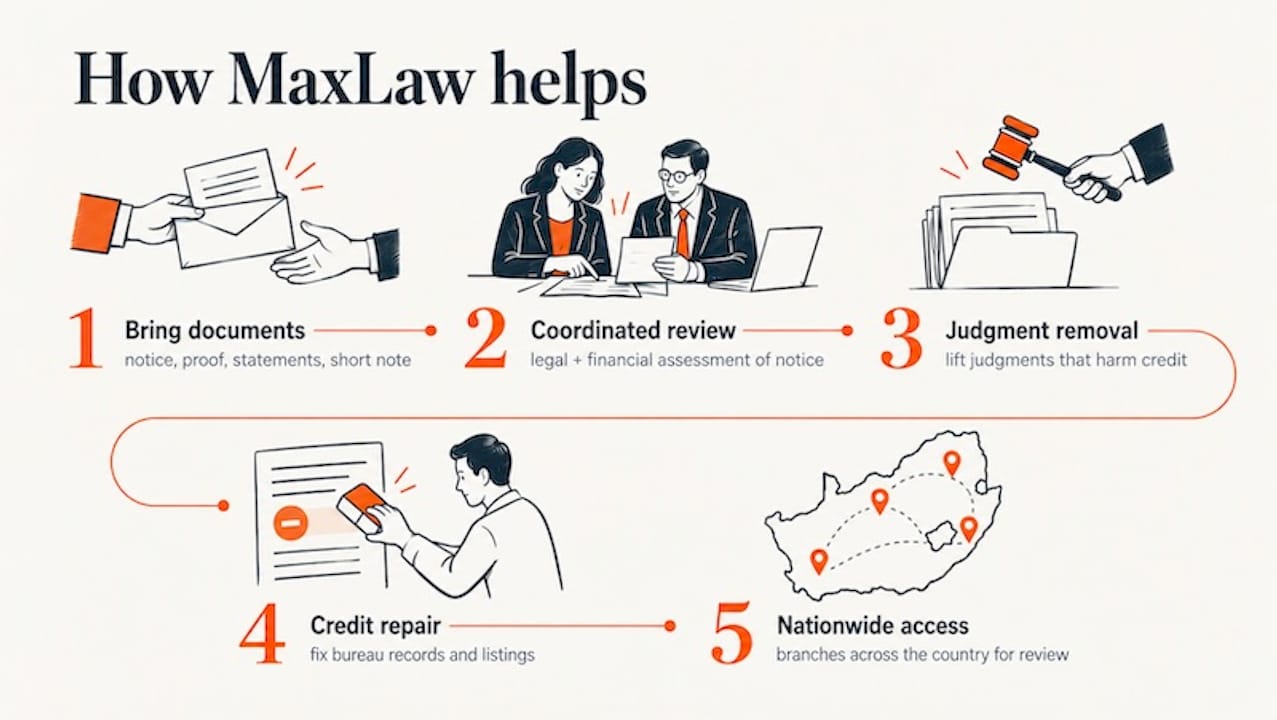
Facing a Section 129 notice does not mean you have to work out the legal angles alone or accept the first outcome a credit provider proposes. We offer assistance with this kind of problem, combining legal review with financial advisory to provide a coordinated plan instead of piecing together advice from different places.
Our debt help services start with a review of whether the notice you received was properly delivered and whether it gave you the resolution options the law requires. Where an account has already reached judgment, our judgment removal work focuses on getting that judgment lifted so it stops weighing down your credit profile. For broader credit cleanup once the immediate notice has been dealt with, our credit repair service addresses bureau records and adverse listings that linger after a dispute is resolved.
Bring the notice, any proof of delivery, your account statements and a short note of what has already been said between you and the credit provider. From there, we can tell you plainly whether the notice holds up, what your realistic options are, and what a renegotiated path forward could look like. With a nationwide reach through branches across the country, getting that first review does not depend on which city you live in.
If a Section 129 notice has landed in your inbox or your postbox, the next useful step is a conversation, not another night spent reading the fine print alone. Get in touch about your options and find out where you actually stand.
This article is general information, not a substitute for advice from a qualified lawyer. Consult a qualified legal professional about your own circumstances before acting on anything here.
FAQ
What happens after a Section 129 notice?
After proper delivery and a waiting period, usually ten business days, the credit provider may approach a court for default judgment or enforcement if the default has not been resolved. If you respond with a written proposal or pursue debt counselling before that period ends, enforcement can be paused while those options are explored.
How long does a Section 129 notice process take?
The notice itself must be followed by a minimum waiting period, commonly ten business days, before legal action can begin. If debt counselling is pursued instead, the National Credit Regulator’s guidance points to a target of 60 business days to complete that process, though individual cases can run longer depending on complexity.
What happens after years of not paying a debt?
Debt does not simply vanish from being ignored: unpaid accounts typically progress to legal action, default judgment, and in some cases repossession of secured assets, while unresolved negative listings continue to affect your credit profile. Addressing the account early, even through a proposed payment plan or debt counselling, generally produces a better outcome than waiting it out.
What are the consequences of non-compliance with section 129?
If a credit provider fails to comply with section 129, meaning it cannot show the notice was properly delivered and gave a genuine resolution option, a court can refuse to grant default judgment or enforcement until that defect is corrected. This is why checking delivery proof and notice content is one of the first things worth doing when you are facing enforcement.
Can I check if a Section 129 notice is genuine?
Verify the sender by contacting the credit provider named on your original agreement directly, using contact details you already have on file rather than any number printed on the notice itself. A genuine notice will reference your actual account number and arrears figure, which you can cross-check against your own statements before responding.